
VIP member
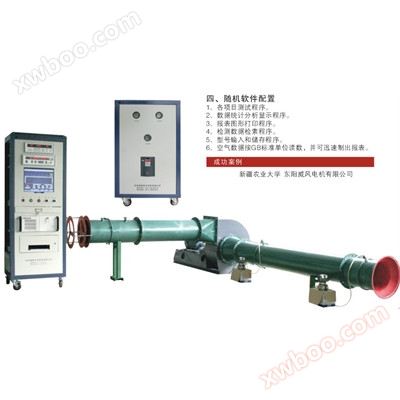
Comprehensive testing system for ventilation fan performance
Host introduction: Testing fan speed, torque, power, rated point wind pressure, air volume measurement, output power PS, efficiency Eff, maximum wind
Product details
Instrument Name: Comprehensive Testing System for Ventilation Fan Performance
Instrument model:
Characteristics: 1. Functional requirements
This type of test bench is controlled by an industrial computer and can test the fan speed
Torque, power, rated point wind pressure measurement, rated point air volume measurement, as well as output power PS, efficiency Eff, maximum wind pressure, and various characteristic curve tests. The characteristic curve test is conducted on the test bench. All project testing programs are collected and tested by computers, and the test results are displayed.
The computer system adopts the WINDOWS Xp operating system, with a beautiful human-machine interface that can collect, record, store, and display various test data and results, print various test data and characteristic curves, and provide computer software that is easy to operate, flexible to adjust, and has a clear and intuitive human-machine interface.
This system adopts manual testing mode and uses variable frequency motors and frequency converters for speed regulation testing
This test bench tests according to GB/T1236-2000 "Performance Testing of Standardized Ducts for Industrial Ventilators".
2、 Test project technical indicators
The test device includes two categories: duct test and chamber test. Generally speaking, fans with higher pressure are tested using duct test benches, while fans with lower pressure are tested using chamber test benches. According to the GB/T1236-2000 standard, they can be divided into four types: Type A, Type B, Type C, and Type D
Install the fan, motor, and torque/speed sensor on a cast iron testing platform. Close the air outlet at one end of the air inlet manufactured according to GB/T1236 standard with a small cardboard plug. Apply the rated voltage to the motor to blow air from the fan. The computer controls the variation of the pressure equalization box inlet orifice plate from maximum to blockage, uniformly changing it 16 times. Measure the wind pressure H and input power P1 at each point, and calculate the output power PS and efficiency Eff
Test Method II: According to IEC and GB standards, obtain data from the above method and draw the following characteristic curves:
pF=f(Q) PZ=f(Q) Eff=f(Q) n=f(Q)
1. Full pressure, static pressure: range 0-50000Pa accuracy: ± 1%
2. Flow rate: Range 0-7000m3/n Accuracy: ± 2%
3. Torque: Range 0-50.0 N.m Accuracy: ± 0.5%
4. Speed: Range 0-5000RPM Accuracy: ± 0.2%
5. Power: Range 0-3000W Accuracy: ± 0.5%
3、 Equipment configuration
1. Electric cabinet: spray painted electric cabinet
2. Workbench: The testing pipeline is made according to the GB/T1236-2000 standard, using a combined testing pipeline of air inlet and outlet. The variable air volume is manually controlled, and all electrical operations are manually controlled.
3. Test bench and pipeline: 1 set of specially made steel test pipeline (see attached figure)
4. Computer configuration: Host (industrial computer), monitor (17 inch LCD display), memory (≥ 256MB), hard drive (≥ 40GB).
5、 电源 AC 50Hz/60Hz 120V/220V 5KVA
6. Main component suppliers:
Industrial control computer (standard industrial control computer), speed and torque sensor,
Differential pressure sensor, wind pressure gauge, differential pressure tube
Online inquiry
-
Contacts
-
Company
-
Telephone
-
Email
-
WeChat
-
Verification Code
-
Message Content
-