
VIP member

Digital polarizing microscope ZXPM-200
Digital polarizing microscope is a commonly used instrument for studying and identifying substances with birefringence using the polarization characte
Product details
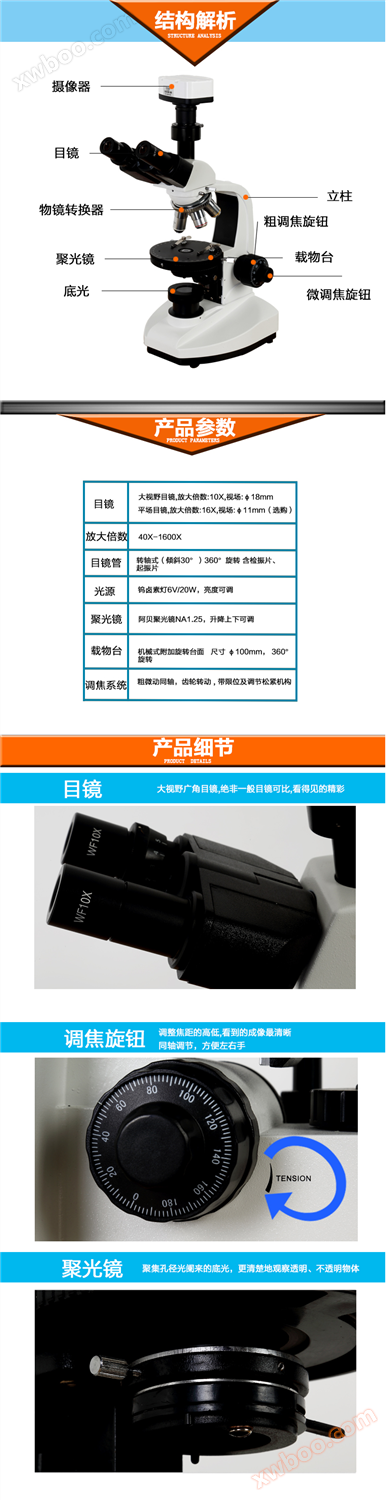
Digital polarizing microscope is a commonly used instrument for studying and identifying substances with birefringence using the polarization characteristics of light. Triple polarized microscope has a wide range of applications, such as observing the structural details of crystalline inclusions in teeth, bones, hair, living cells, animal muscles, plant fibers, etc., and analyzing the process of degeneration. It is also possible to observe the crystal structure of various salts in inorganic chemistry, which is not visible under natural light.
The digital polarizing microscope imaging system is a technological product developed by combining optical microscopy technology, photoelectric conversion technology, and computer image processing technology. It is easy to observe polarized images on a computer monitor, analyze polarized spectra, and output and print images.
Standard configuration
model |
(Three eye polarizing microscope) |
eyepiece |
Wide field of view WF10X (Φ 18mm) |
objective lens |
PL 4X/0.10 working distance: 17.5mm |
PL 10X/0.25 working distance: 6.6mm | |
PL 40X/0.65 working distance: 0.64mm | |
PL 100X/0.80 working distance: 0.19mm | |
condenser |
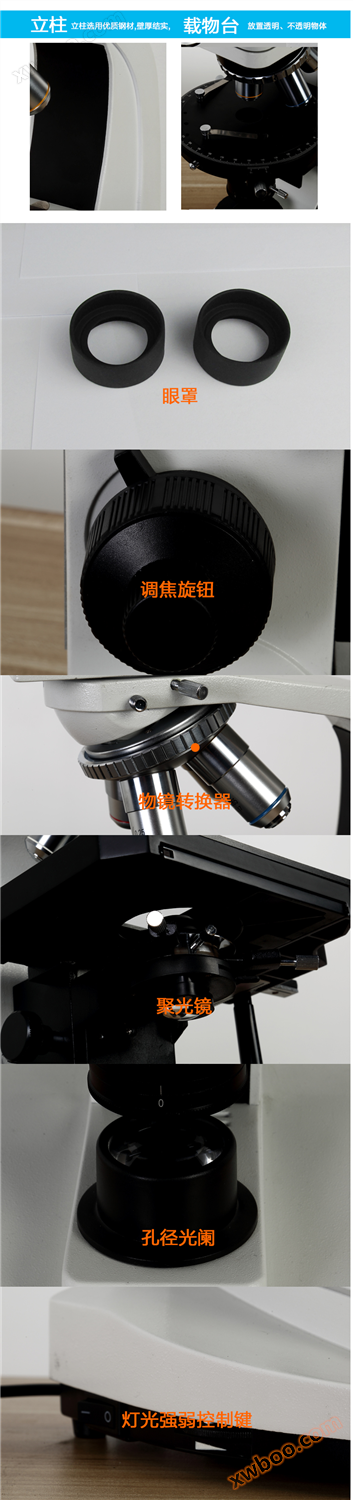
Abbe spotlight with a numerical aperture of 1.25 and a variable light barrier |
Carrier platform |
Mechanical additional rotating table with dimensions of 100mm and 360 ° rotation |
converter |
Four holes (adjustable converter center) |
Eyepiece tube |
Three eyes, pivot type (tilted 30 °), 360 ° rotation including vibration detection plate and starting plate |
focusing mechanism |
Coarse micro coaxial, gear rotation, with limit and adjustable tension mechanism |
Online inquiry
-
Contacts
-
Company
-
Telephone
-
Email
-
WeChat
-
Verification Code
-
Message Content
-