
VIP member
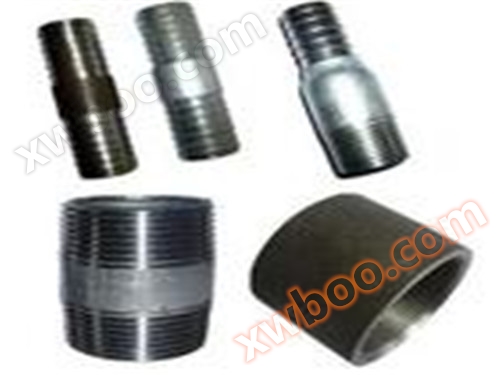
Hongxin carbon steel outer wire joint
In order to facilitate the disassembly and repair of equipment in the pipeline, in addition to the use of flexible joints during pipeline installation
Product details
Galvanized steel pipe outer wire joint
In order to facilitate the disassembly and repair of equipment in the pipeline, in addition to the use of flexible joints during pipeline installation; Root nut tie, also known as root clamp, is a locking nut that consists of a short pipe section with one end as a short thread and the other end as a long thread (without a tip at the root), a root nut, and a pipe clamp with a continuous thread on the inner wall to form a long thread. Its function is the same as that of a flexible joint, used as a detachable flexible connection. When used on radiator bushings, the continuous thread pipe clamp can also be omitted; A flange plate, consisting of two pieces on the left and right, functions as a flexible joint. The specification is a diameter of over 50mm. Due to the fact that large valves often have flange interfaces at both ends, flange plates are also commonly used for connecting pipelines and valves.
Joint fittings, also known as pipe fittings, connectors, joint parts, etc. Pipes in various pipeline systems are connected by different joint fittings to form pipe steel.
1. Malleable cast iron (Magang) fittings are made of malleable cast iron and connected to the pipeline with threads. The work pressure is within 0.1Mpa. Its appearance is characterized by thick edges at the ends.
When steel pipes and malleable cast iron fittings are connected by threads, if the working pressure is high (but within 1.6Mpa), steel fittings can be used. Steel fittings are made of carbon steel, commonly known as wrought iron fittings. It has good weldability and can be used in areas that require welding, such as steel pipe clamps commonly used to connect steel equipment such as boilers or water tanks.
3. Water supply cast iron fittings are processed by casting gray cast iron. There are two types of water supply cast iron fittings: socket type and flange type. Their use is similar to that of malleable cast pipes, mainly including the following types: cross pipe and T-shaped pipe (including three socket cross pipe, three disc cross pipe, four socket cross pipe, four disc cross pipe, double socket T-shaped pipe, double disc T-shaped pipe, three socket T-shaped pipe, double socket single disc T-shaped pipe, single socket double disc T-shaped pipe); 90 ° bend, 45 ° bend; Fork tube; Type B pipe; Fire hydrant pipes; Sleeve and so on.
4. Drainage cast iron fittings mainly include socket and bend pipes, 90 ° elbows, 45 ° Y-shaped tees, 90 ° T-shaped tees, 90 ° TY tees, diagonal tees, positive tees, TY reducing tees, reducing tees, pipe clamps, T-shaped bottle mouth tees, 45 ° elbows, Y-shaped reducing tees, socket and cleaning ports, S-shaped water storage bends, P-shaped storage bends, floor drains, and other varieties. Note: Various types of joint fittings can be made of different materials. Currently, plastic joint fittings have been widely used. As only the materials used are different, they will not be repeated here.
Online inquiry
-
Contacts
-
Company
-
Telephone
-
Email
-
WeChat
-
Verification Code
-
Message Content
-