
VIP member

MSCL-CIS Core Optical Linear Scanner
Geotek, a British company, is the designer and manufacturer of the world's best-selling core equipment MSCL (Multi Sensor Core Logger Core Comprehensi
Product details
Geotek Company Introduction:
Geotek, a British company, is the designer and manufacturer of the world's best-selling core equipment MSCL (Multi Sensor Core Logger Core Comprehensive Testing System, also known as Multi Parameter Core Scanner). Almost every laboratory engaged in core research work in the world (scientific research, engineering exploration, oil drilling, etc.) has installed MSCL, with over 220 users. MSCL has very stable, reliable, and durable performance, suitable for both laboratory and field use. It has been widely used in core libraries, geological key laboratories, temporary field laboratories, offshore survey ships, deep-sea drilling ships, and engineering ships around the world. Geotek is the most commonly used core analysis equipment by scientists. Wherever there are rock cores on Earth, there are Geotek products.
If a core is worth taking, it's worth logging. ...岩芯宝贵,数据无价。

Optical core scanner (color photography)
MSCL-CIS
MSCL-CIS is one of the 13 MSCLs in the MSCL series of integrated core testing systems produced by GEOTEK in the UK (see product list above). The MSCL-CIS core imaging scanning system from Geodek is a low-cost, fast, and high-resolution linear scanning imaging system. MSCL-CIS uses Geodek's high-performance Geoscan V fifth generation camera, which can generate resolution images of up to 1000 pixels per centimeter across the entire core width. MSCL-CIS can be applied to cut or flat sediment or rock cores. The image format generated by the MSCL-CIS system is TIFF, which can be easily post processed using third-party software.
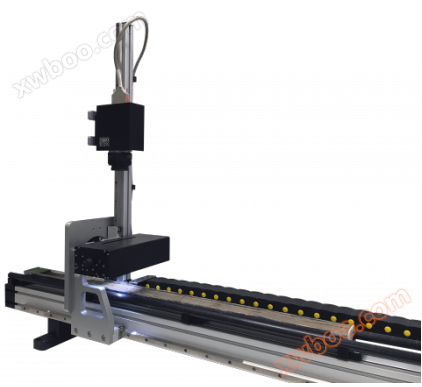
MSCL-CIS (equipped with Geoscan V fifth generation camera)
Marine and lake sediment cores are very precious and hard won, and they are also very delicate. When they are cut open and come into contact with air, the oxidation of the air causes changes in the composition and properties of the cores. If surface optical linear scanning (high-definition photography) is not performed immediately, it will result in the loss of valuable information. With MSCL-CIS, the most primitive state of the rock core can be fully and clearly recorded, and the complete optical images of the rock core can form a complete database, which corresponds one-to-one with other testing and analysis data for filing.
MSCL-CIS can be installed as a standalone device on a suitable desktop. In addition, the Geoscan V linear camera can also be installed in the MSCL-XZ system or the standard MSCL-S.

Geoscan V camera installed in MSCL-S system
Linear scanning image
MSCL-CIS continuously collects linear image data along the core, and the quality of linear scanning images is much better than that of regional imaging cameras, because it is not affected by the uniformity of light, spherical distortion, and image mixing and stitching. The entire linear image is highly suitable for sub millimeter level image analysis.
Simple and fast setup
The Geoscan V camera is equipped with autofocus and aperture functions, which can be set up intuitively, simply, and quickly through Geotek's dedicated imaging software. The entire linear scanning process and movement can be easily controlled automatically using imaging software.
Some rock cores contain a lot of water or are in a state of fluid saturation, which can cause strong specular reflection during the imaging process, resulting in blurry images. For this moist core sample, the MSCL-CIS system utilizes the orthogonal polarization of the light source and lens to avoid imaging oversaturation and significantly improve image clarity.
High, higher, highest resolution
The standard resolution is to capture 100, 200, or 400 linear scan images per centimeter, equivalent to standard pixel sizes of 100, 50, or 25 μ m. The output image is a 48 bit RGB TIFF image, which can be quickly and easily converted to JPEG or other formats.
True color separation
The GEOSCAN V fifth generation linear scanning camera from Geodek has a CCD imaging sensor with approximately 5340 pixels, and the incident light passes through a red, green, and blue color filter to produce true RGB color separation. Within the entire width range of the rock core, the standard image resolution is 200 pixels per centimeter, and the highest image resolution can reach 1000 pixels per centimeter.
The standard resolution of RGB analysis data for each color channel along the direction of the rock core is 0.1mm. Users can perform small-scale and precise analysis on some special rock cores, such as thin plate-like rock cores, bioturbated rock cores, and complex real geological rock cores. The average image data can be converted into RGB values and stored separately in a specific folder for quantitative comparison.
calibration
The scanning camera is calibrated before leaving the factory and can also be calibrated on-site using standard photography cards with 90% white or 18% gray. The light source intensity and aperture settings can be controlled through software to ensure qualitative and quantitative comparison between rock cores.
Automatic ruler
Each Geotek core scan image is accompanied by an XML metadata file containing important information related to the condition of the core and image. The depth scale can be automatically generated next to the image, describing the depth of the rock core section or the actual depth of the rock core.
Advanced camera control
The Geoscan V camera has automatic focusing, aperture, and light source control functions, which can be easily controlled through Geodek's imaging scanning software. Users can set the camera and light source through software to obtain optimal image exposure parameters, etc.
application
● Correlation stratigraphy
● Core archive
● Core quality assessment
● Color analysis
Mineralogy

Surface image of rock core scanned by MSCL-CIS
Online inquiry
-
Contacts
-
Company
-
Telephone
-
Email
-
WeChat
-
Verification Code
-
Message Content
-