
VIP member
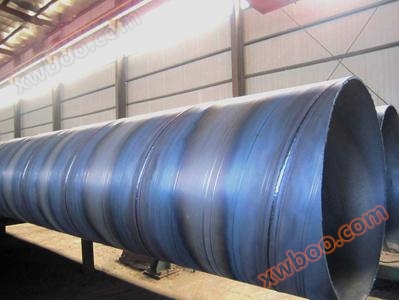
spiral steel pipe
Spiral steel pipe execution standard: GB/T9711-2011 Steel pipes for pipeline transportation in the petroleum and natural gas industry (the latest nati
Product details
Spiral steel pipe execution standard:
GB/T 9711-2011 Steel pipes for pipeline transportation in the petroleum and natural gas industry (the latest national standard replaces GB/T 9711.1-1997 and GB/T 9711.2-1997)
SY/T 5037-2012 Submerged arc welded steel pipes for ordinary fluid transportation pipelines (latest petroleum department standard replaces SY/T 5037-2000)
SY/T 5040-2012 Welded steel pipes for piles (latest petroleum standard replaces SY/T 5040-2000)
Spiral steel pipe material:
Can be produced as needed Q235、10#、20#、Q345(16Mn)、L245、L290(X42)、L320(X46)、L360(X52)、L390(X56)、L415(X60)、L450(X65)、L485(X70)、L555(X80)
Product Features

-
Due to the use of steel plate spiral extrusion molding, it can overcome the material and equipment requirements of straight seam welded pipes and seamless steel pipes, and can produce large-diameter steel pipes with larger export diameters using ordinary steel plate coils.
-
During the forming process, the steel plate deforms uniformly, with minimal residual stress and no scratches on the surface. The processed spiral steel pipes have greater flexibility in the size specifications of diameter and wall thickness, especially in the production of high-grade thick walled pipes, especially small and medium-sized thick walled pipes, which have advantages that other processes do not have, and can meet more requirements of users in terms of spiral steel pipe specifications.
-
By adopting advanced automatic double-sided submerged arc welding technology, welding can be achieved at the appropriate position, and defects such as misalignment, welding deviation, and incomplete penetration are less likely to occur, making it easy to control the welding quality.
-
Conduct 100% quality inspection on steel pipes, ensuring that the entire production process is under effective testing and monitoring, effectively guaranteeing product quality.
-
All equipment on the entire production line has the function of networking with the computer data acquisition system to achieve real-time data transmission, and the technical parameters during the production process are collected and analyzed by the central control room.
-
Due to the fact that the rolling direction of spiral welded pipes is not perpendicular to the axis of the steel pipe, while the rolling direction of steel plates for straight seam steel pipes is perpendicular to the axis of the steel pipe, the crack resistance of spiral welded pipe materials is superior to that of straight seam steel pipes.
-
The spiral welded pipe production equipment adopts online continuous inspection to ensure the welding quality of the weld seam. Continuous inspection is conducive to monitoring welding defects, stabilizing welding quality, ensuring welding grade, and providing good guarantee for pipe quality.
-
The production of spiral steel pipes is a stable and continuous process under the same working conditions, so the produced pipes have excellent pipe opening ovality and end face perpendicularity, ensuring the accuracy of on-site steel pipe welding and assembly, and facilitating on-site welding.
-
Due to the internal pressure on pipelines, two main stresses are usually generated on the pipe wall, namely radial stress δ Y and axial stress δ X. The composite stress at the weld seam is δ=δ Y (l/4 sin2 α+cos2 α) 1/2, where α is the helix angle of the spiral welded pipe weld seam. The helix angle of the spiral welded pipe weld is generally 50-75 degrees, so the composite stress at the spiral weld is 60-85% of the main stress of the straight seam welded pipe. So under the same working pressure, the wall thickness of spiral welded pipes with the same diameter can be reduced compared to straight seam welded pipes.
Application field
-
-
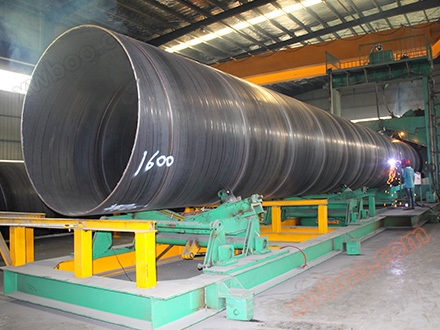
1. Spiral steel pipes are mainly used in various fields such as water supply engineering, petrochemical industry, chemical industry, power industry, agricultural irrigation, bridge infrastructure construction, urban municipal construction, etc. They are one of the twenty key products developed in China.
2. Used for liquid transportation: water supply pipes, drainage pipes, irrigation pipes, chemical liquid transportation pipes.
3. Used for gas transportation: gas pipelines for coal gas, steam, natural gas, and other gases.
4. For structural purposes: pile driving pipes, pipes used for bridge pier foundations, docks, roads, building structures, etc.
Online inquiry
-
Contacts
-
Company
-
Telephone
-
Email
-
WeChat
-
Verification Code
-
Message Content
-